

Behind the Mask: How Three Traditions Hide the Face to Reveal the Truth

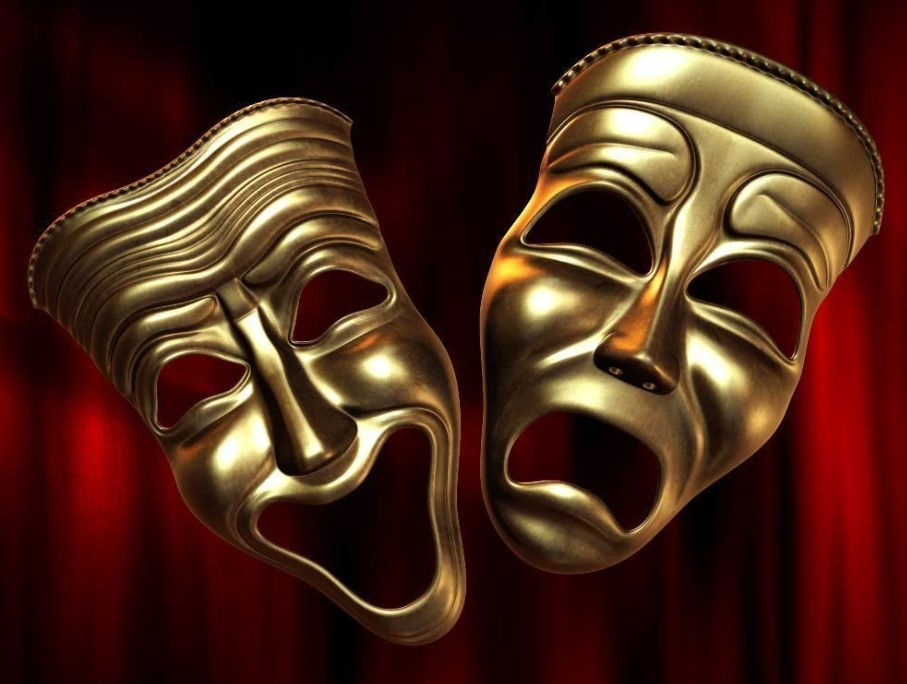
"The mask doesn't conceal it reveals. The things we wear change us." — Matthew Gregory
We often think of a mask as something that hides who we are. You wear one to disappear, become anonymous, keep a secret, or avoid being seen. But after talking with performers from many different theater traditions on this podcast, I have come to believe the opposite. In theater, a mask can be one of the most powerful tools for revealing truth. It doesn't hide the performer. It reveals something that the human face alone cannot express.
David Alan Roby, an actor and teacher of commedia dell'arte, explained that the half-masks used in this tradition create an interesting challenge. Because the mask freezes the face, actors cannot rely on a raised eyebrow or a small smile to express emotion. Instead, everything moves into the body, including the spine, the hands, and the way the head is held. The mask demands honesty because you cannot fake a performance with facial expressions alone. Matthew Gregory, who leads a commedia troupe called the Department of Fools, shared a similar idea. He told me that the mask doesn't hide the actor. It reveals parts of the performer that ordinary training often cannot reach. His troupe even has a saying that captures this idea: the things we wear change us.
This idea is not unique to the West. In Japan, the mask takes on an almost sacred role. Carol Fisher Sorgenfrei, a scholar of Japanese and intercultural performance, introduced me to the masks of Noh theater. Each mask is carved with a single, almost neutral expression. Yet that expression seems to change as the actor moves. A slight tilt toward the light can make the face appear joyful, while a tilt into the shadows can make it seem sorrowful, even though the mask itself never changes. The emotion comes from the actor's movement and the audience's imagination working together. Carol also shared something about Noh that has stayed with me. There is a saying that to truly appreciate Noh, you almost fall asleep. You enter a dreamlike state where the performance surrounds you, leaving you fully aware but somehow transported.
Then there is Kathak, the classical dance tradition of North India, which seems at first to challenge this idea because it uses no mask at all. Chandrayee Bhattacharya, a Kathak dancer and teacher, performs with her face completely uncovered. Yet the principle is surprisingly similar. In the storytelling tradition known as abhinaya, the face becomes a carefully trained instrument. Through the eyes, eyebrows, and mouth, the dancer brings characters, gods, and entire stories to life. The uncovered face becomes much like the carved mask in Noh. It is no longer simply the performer's everyday face. It becomes a canvas for storytelling. And because the story is carried through the whole body, Chandrayee explained that audiences can understand and feel it even if they do not speak the language.
When you place these three traditions side by side, a clear pattern appears. In commedia dell'arte, the mask hides the face so the body must speak. In Noh, the mask stays still so movement can bring it to life. In Kathak, there is no physical mask, but the face is trained with the same discipline and purpose. In every tradition, performers let go of their ordinary expressions and gain access to something larger than themselves.
There is a lesson here not only for performers but perhaps for all of us. We often think that being authentic means showing the world our unfiltered selves. These traditions suggest something more thoughtful. Sometimes we need structure, discipline, or even a mask before we can express our deepest truths. The mask is not the opposite of honesty. Across centuries and cultures, it has become one of the oldest ways of revealing it.


Comments